

Your Website Isn't Losing Traffic. It's Losing Customers.
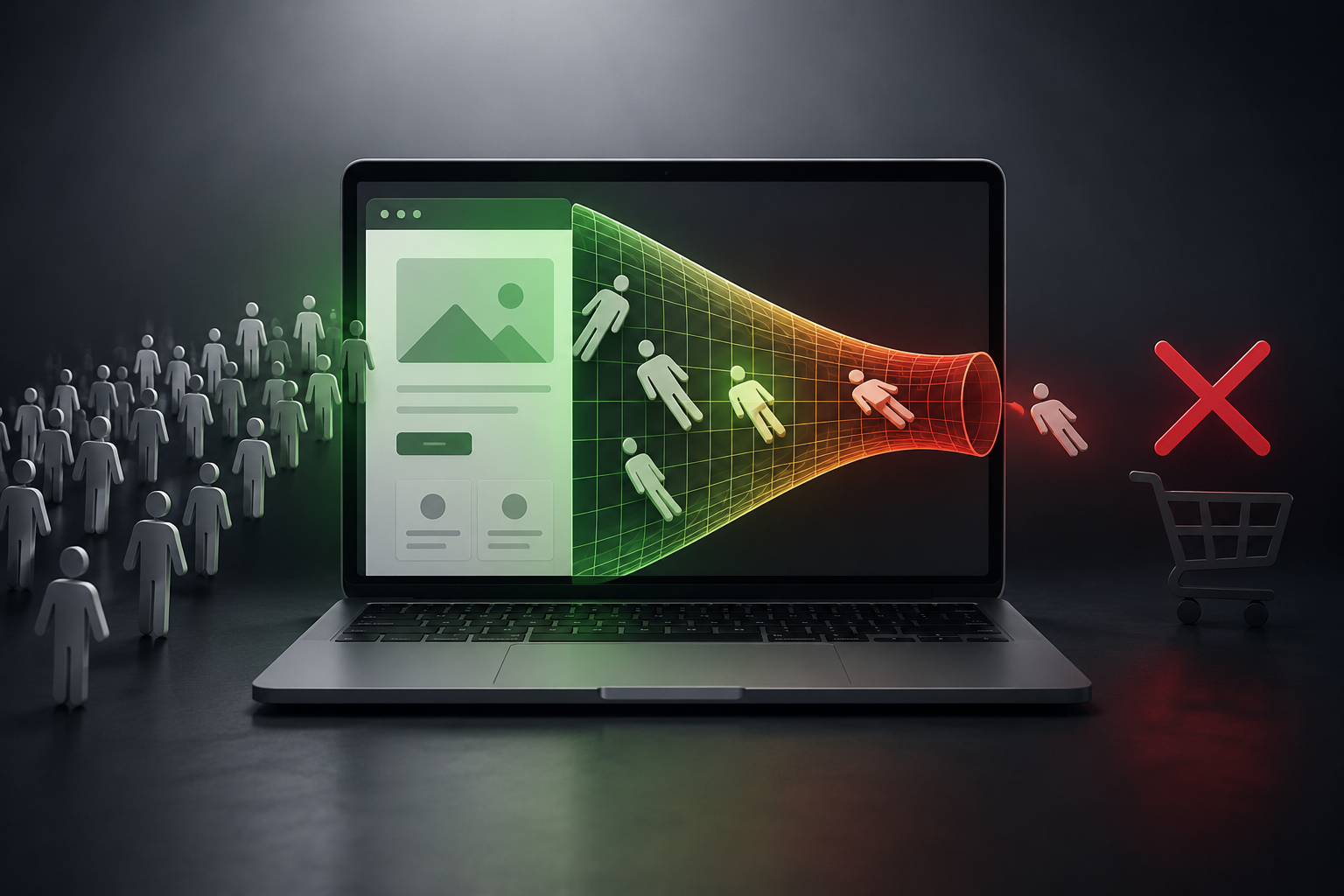
Picture two business owners.
The first spends $2,000 a month on ads and doubles their website traffic. The second spends nothing extra, but fixes the way their website handles the visitors it already gets. Six months later, the second business has more new customers. That's not a trick question. It's the reality most small business owners never get told, because "get more traffic" is a much easier thing to sell than "fix what happens after someone lands on your site." If you've been chasing traffic and wondering why the phone still isn't ringing enough, this article is for you.
The Traffic Trap: Why More Visitors Doesn't Mean More Sales
Traffic feels good. It's a number that goes up on a dashboard, and it's easy to celebrate. But traffic by itself doesn't pay your bills. Customers do. Here's the math most business owners skip: if your website converts 1% of visitors into leads, doubling your traffic from 1,000 to 2,000 visitors gets you from 10 leads to 20 leads. That's real growth, but it also cost you real ad spend to get there. Now imagine instead you fixed your website so it converts at 3% instead of 1%. Your original 1,000 visitors now produce 30 leads. You tripled your results without spending a single extra dollar on traffic.This is the trap: business owners assume a slow month means "we need more people to see us," when the actual problem is usually "we're not doing anything useful with the people who already see us."
Pro Tip: Before you spend another dollar on ads, calculate your current conversion rate. Take your monthly leads, divide by monthly visitors, and multiply by 100. If that number is below 2%, more traffic will only amplify a problem you haven't fixed yet.
Why Most Website Visitors Disappear Forever
Most visitors who land on your website will never come back. Not because they didn't like what they saw. Because they forgot you exist within hours. Think about your own browsing habits. You look at three plumbers, two dentists, or four contractors in one sitting while comparing options. By the next day, you probably can't remember which one had the nicer website. You remember whoever texted you back first, or whoever showed up highest when you searched again. This is why "they'll remember us and come back later" is one of the most expensive assumptions in small business marketing. Research on lead response behavior backs this up in a big way: studies from MIT and Harvard Business Review found that businesses which respond to a new lead within 5 minutes are dramatically more likely to actually connect with that person than businesses that wait even 30 minutes, and the odds of qualifying that lead follow a similar steep drop. One widely cited figure from that same body of research puts it plainly: the majority of customers end up buying from whichever business responds to them first, not necessarily the best one. In other words, the business that talks to the visitor first usually wins the customer, even if a competitor down the street objectively does better work.
The Most Common Conversion Killers
Most small business websites lose customers for a small, repeatable set of reasons. Here they are, in the order we see them most often: No follow up. A visitor fills out a form or calls and leaves a voicemail. Nobody responds for a day, sometimes longer. By the time someone calls back, the customer already booked with a competitor. Slow response times. Even when a business does respond, it's often hours later. As covered above, that delay is often the entire difference between winning and losing the customer. Poor websites. Confusing layouts, outdated design, or a site that doesn't work well on a phone (where most visitors are browsing from) all quietly push people away before they even get to your offer. Weak calls to action. A homepage with no obvious next step leaves visitors unsure what to do, so they do nothing. No email capture. Visitors who aren't ready to buy today, but might be next month, leave with no way for you to stay in touch. That's a lead lost forever instead of nurtured. No appointment booking. If booking a call or consultation requires a phone call during business hours, you're filtering out every visitor browsing at night or on a weekend. Lack of trust. No reviews, no testimonials, no clear proof that real customers had a good experience. Visitors don't buy from businesses they're not sure they can trust. Common Mistake: Treating these as seven separate problems. In practice, they usually all show up together on the same website, because they share the same root cause: nobody built a system, they just built a website and hoped.
What the Numbers Actually Say
It's worth sitting with just how much visitor activity most businesses lose without realizing it.
The typical website across all industries converts somewhere around 2 to 3 percent of visitors into leads or customers. That means roughly 97 to 98 out of every 100 people who land on your site leave without taking any action at all.
The gap between an average website and a top performing one is large and growing. Businesses converting in the top tier of their industry often convert at 4 to 5 times the rate of the average site.
Mobile traffic now makes up the majority of visits for most small businesses, yet mobile consistently converts at roughly half the rate of desktop, mostly due to friction: slow loading pages, clunky forms, and hard to tap buttons.
On the follow up side, studies analyzing hundreds of thousands of real sales leads have found that responding within 5 minutes can make you many times more likely to actually connect with a lead compared to waiting even 30 minutes, and yet most businesses take hours, sometimes over a day, to respond.
Put together, these numbers describe a pattern: most small businesses aren't struggling because nobody is visiting their website. They're struggling because almost everyone who visits leaves without becoming a customer, and almost everyone who does reach out doesn't hear back fast enough to stay interested.
Real World Example
A local med spa was spending steadily on social ads and getting a healthy stream of profile visits and website clicks every week. Bookings, though, stayed flat month over month. When they looked closer, the pattern was obvious. Their website had no way to book directly. Every visitor had to call during business hours, and most inquiries came in through Instagram DMs in the evening, after the front desk had gone home. Those messages often sat unanswered until the next morning, sometimes longer. The fix wasn't more ads. It was closing the gap between "interested" and "booked." Once they added a simple online booking option and a way to respond to messages faster, the same traffic they'd already been paying for started converting into actual appointments, without spending a single additional dollar on ads. The lesson isn't unique to med spas. Restaurants losing reservations to whoever answers the phone first, contractors losing quote requests to slow callbacks, and gyms losing sign ups to a confusing membership page are all the same story wearing a different outfit.
Signs Your Business Has a Conversion Problem
You likely have a conversion problem, not a traffic problem, if:
Your website gets a steady stream of visitors, but very few actually call, message, or book
You're not sure how many leads you got last month, because nothing is tracking it
Leads often wait hours (or longer) for a response
Your website doesn't have a clear way to book an appointment or request a quote without a phone call
You have no email list, and no way to follow up with visitors who didn't buy right away
Your reviews exist, but they're not visible anywhere on your actual website
You've never tested a different headline, button, or offer on your site to see what performs better
If three or more of these sound familiar, the good news is real: this is fixable, and it's usually far cheaper to fix than to keep buying traffic that leaks out the bottom of a broken funnel.
So What Actually Fixes This?
Here's where it gets interesting. Fixing a conversion problem the traditional way takes time. It means rebuilding your website, setting up follow up systems, training staff to respond faster, building out email sequences, and monitoring everything closely enough to catch when a lead slips through. Most small business owners don't have the hours in the week for that. That's the real bottleneck. It's not that business owners don't know follow up matters. It's that follow up, tracking, booking, and nurturing all take constant attention that a busy owner simply doesn't have.
What if a system could handle a big chunk of this automatically, the moment a visitor takes action, without you having to be the one watching every notification?
That's not a hypothetical. It's already happening quietly inside a lot of small businesses right now. We'll get into exactly how in the next article.
Frequently Asked Questions
1. What's the difference between a traffic problem and a conversion problem? A traffic problem means not enough people are finding your website. A conversion problem means people are finding it, but leaving without becoming a customer. Most small businesses assume they have the first problem when they actually have the second.
2. How do I know my conversion rate? Divide your total leads (calls, bookings, form fills) by your total website visitors over the same time period, then multiply by 100. Most website analytics tools and social platforms will show you visitor counts if you don't already track this.
3. What is considered a good website conversion rate? Averages vary by industry, but most websites convert somewhere around 2 to 3 percent of visitors. Anything meaningfully above that puts you ahead of most competitors in your space.
4. Why does response time matter so much? Research on sales leads consistently shows that responding within the first few minutes dramatically increases your odds of actually connecting with a potential customer, compared to waiting even half an hour. The longer the delay, the more likely that person has already moved on to a competitor.
5. Does a slow website really affect sales? Yes. A slow loading page increases the chance a visitor leaves before they even see your offer, and it can hurt your search ranking too, which means fewer people find you in the first place.
6. I have good reviews. Why isn't that enough? Reviews only help if visitors actually see them. If your reviews live on a separate page nobody clicks, or aren't visible near your call to action, they're not doing the trust building work they could be.
7. Should I redesign my website first, or fix follow up first? Follow up usually has the faster, cheaper payoff. A beautiful website with no fast follow up system still loses leads to slower competitors. Fix the leaks before you invest in a bigger redesign.
8. Can I fix this myself, or do I need outside help? Some of this you can absolutely tackle yourself, especially simplifying your website and adding online booking. Other parts, like instant automated follow up or lead nurturing, are much easier with the right tools in place, which is where a lot of small businesses start looking for outside support.
9. How long does it typically take to see results after fixing conversion issues? Many businesses see a difference within the first few weeks, especially around follow up speed and booking friction, since those changes affect leads you're already generating right now.
10. What's the first thing I should fix? Start with response time. It's usually the fastest, cheapest fix, and the data shows it has an outsized impact on whether a lead becomes a customer at all.
Next Steps
More traffic isn't the villain here, but it's also not the hero small business owners are told it is. If your website and follow up process are leaking customers, more visitors just means more people falling through the same cracks. The businesses pulling ahead right now aren't necessarily getting discovered by more people. They're doing more with the people who already find them. So here's a question worth sitting with: what if a lot of these fixes, the fast follow up, the lead capture, the nurturing, could happen automatically, without adding another task to your plate? That's exactly what we're unpacking next.
Ready to See What's Holding Your Business Back?
Get your FREE AI Growth Audit from Yes Yes Marketing. We'll review your website, SEO, Google Business Profile, social media, and customer journey to uncover missed opportunities and show you exactly how AI can help your business grow.
